



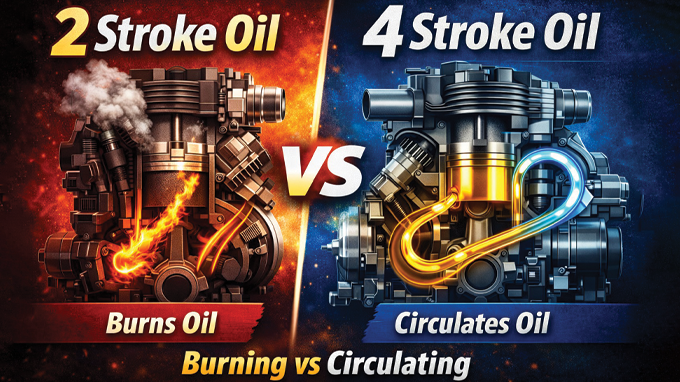
2 Stroke Oil vs 4 Stroke Oil
2 Stroke Oil vs 4 Stroke Oil: What’s the Real Difference?
The comparison between 2-stroke oil and 4-stroke oil is one of the most frequently searched topics among bike owners, mechanics, and everyday users, but most explanations become overly technical. The truth is simple: the real difference is not just the engine cycle, it’s how engine oil behaves inside the engine.
Why does 2 stroke oil burn completely, while 4 stroke oil stays inside the engine for thousands of kilometres?
Why does one produce visible smoke and the other doesn’t?
And most importantly, what happens if you accidentally use the wrong oil?
Let’s break it down in a way that actually makes sense.
Why Engine Oil Matters More Than Engine Design?
Engine oil is not just an add-on because it is the lifeline of any engine. Whether it’s a bike, generator, chainsaw, or car, oil performs four critical jobs:
-It reduces friction between fast-moving parts
-Controls engine temperature
-Prevents wear and corrosion
-Keeps internal components clean
The key difference in 2 stroke oil vs 4 stroke oil lies in how these jobs are performed. That difference directly impacts smoke, oil consumption, maintenance cost, and overall engine life.
How 2 Stroke Engine Oil Works (Oil That Is Designed to Burn)?
In a 2-stroke engine, oil and fuel are mixed together before entering the engine. Once this mixture reaches the combustion chamber, both fuel and oil burn simultaneously.
During this process, the oil lubricates internal components for a very short time and then burns completely, exiting through the exhaust as smoke. Because of this, 2 stroke oil is specially formulated to burn cleanly without damaging the engine.
This is why 2-stroke oil:
-Is consumed continuously
-Produces visible exhaust smoke
-Requires frequent refilling
You’ll typically find 2-stroke oil used in older motorcycles, scooters, chainsaws, brush cutters, water pumps, and small generators.
How 4 Stroke Engine Oil Works (Oil That Never Burns)?
In contrast, a 4-stroke engine uses a separate lubrication system. The oil is stored in the engine sump and never mixes with fuel.
The oil circulates through the engine, lubricates moving parts, absorbs heat and impurities, and then returns to the sump. This cycle continues until the oil is drained and replaced during a scheduled service.
Because oil never enters the combustion chamber, 4 stroke oil must not burn at all. Instead, it is designed for long-term stability, strong lubrication, and extended engine protection.
This is why most modern bikes, cars, and generators follow oil-change intervals rather than continuous oil top-ups.
The Core Difference: Burning Oil vs Circulating Oil
The biggest distinction in 2 stroke oil vs 4 stroke oil comes down to one simple fact:
-2 stroke oil burns after lubricating
-4 stroke oil circulates repeatedly without burning
This single difference explains why:
-2-stroke engines consume more oil
-4-stroke engines offer better fuel efficiency
-Oil formulations are completely different
-Interchanging oils can cause serious damage
What Happens If You Use the Wrong Engine Oil?
Using the wrong oil is one of the most common and even expensive mistakes.
If you use 4 stroke oil in a 2 stroke engine, the oil does not burn properly. This leads to heavy carbon deposits, spark-plug fouling, engine choking, and in extreme cases, engine seizure.
On the other hand, using 2 stroke oil in a 4 stroke engine causes the oil to burn unintentionally. This results in excessive smoke, weak lubrication under load, faster wear, and reduced engine life.
No matter how similar the viscosity looks, 2 stroke oil and 4 stroke oil are never interchangeable.
Smoke, Emissions & Oil Formulation
Smoke is not just an exhaust issue because it’s an oil design issue.
2-stroke engines produce more smoke because oil burns with fuel. Poor-quality oil increases smoke levels and carbon buildup, which is why many regions are phasing out 2-stroke engines due to emission concerns.
4-stroke engines, on the other hand, produce cleaner exhaust because oil never enters combustion. This makes it easier for them to meet modern emission standards.
Using high-quality engine oil plays a major role in reducing smoke, especially in 2-stroke applications.
Maintenance Cost & Oil Consumption Difference
From an ownership perspective, oil behaviour directly impacts cost.
2-stroke engines require continuous oil refilling, which increases long-term oil consumption.
4-stroke engines require periodic oil changes, but overall oil usage is lower.
While 2-stroke engines may appear mechanically simpler, 4-stroke engines usually offer longer engine life and lower maintenance costs when maintained properly.
Which Engine Oil Is Better for Engine Life?
Engine life doesn’t depend on whether the engine is 2-stroke or 4-stroke because it depends on using the correct oil, of the right quality, at the right time.
The right engine oil:
-Reduces internal wear
-Keeps the engine cleaner
-Improves performance
-Prevents costly breakdowns
-No engine can survive long on poor-quality or incorrect oil.
DISTRIBUTOR
HAPPY CUSTOMER
AWARDS
STATES COVERED